Why Go Over the Waves When You Can Go Through Them?
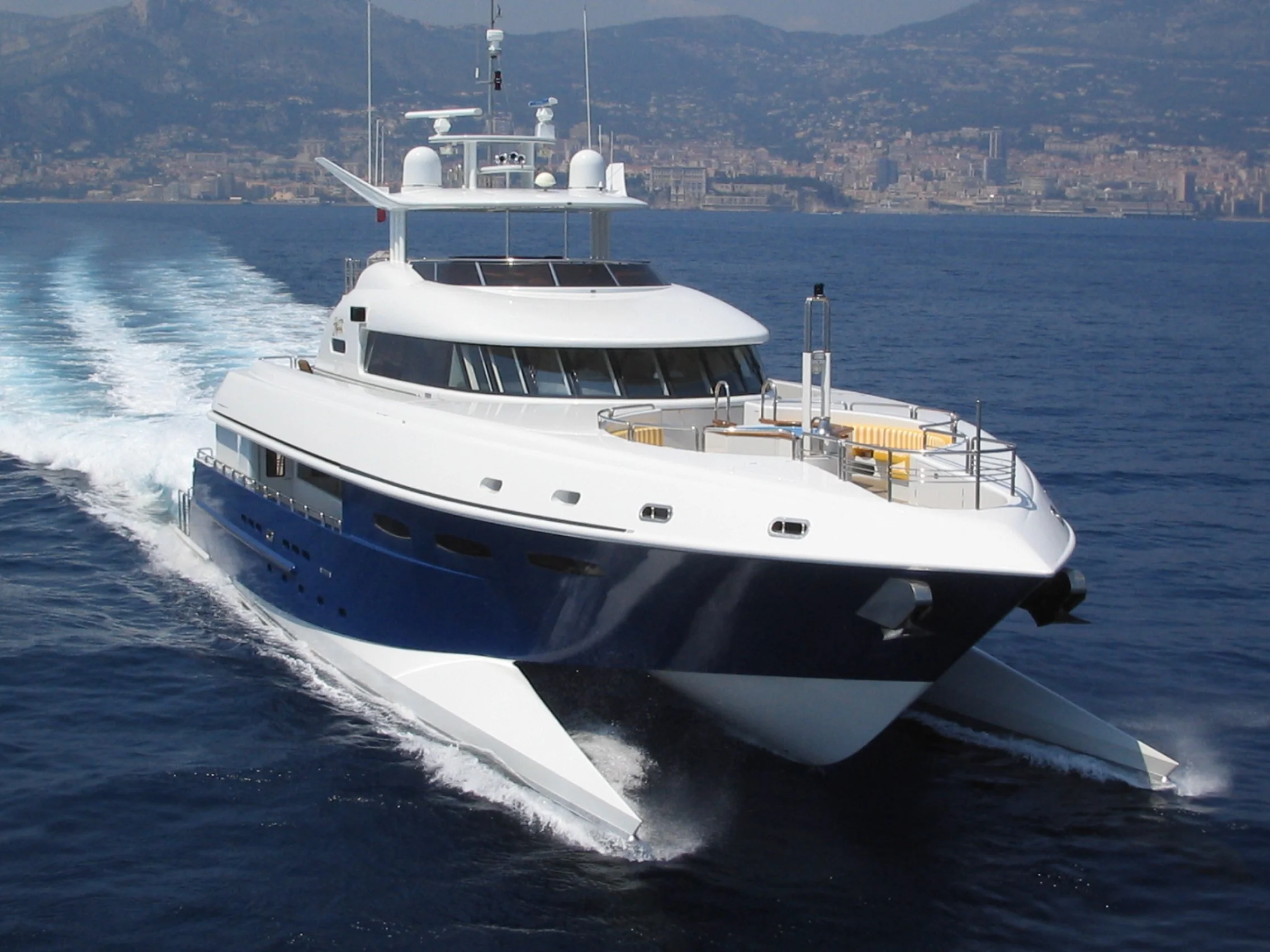
A different conversation between yacht and ocean
There is a moment offshore when every captain is reminded of who is really in charge. The horizon disappears behind a wall of water, the bow begins its climb, and several hundred tonnes of yacht are lifted toward the sky. For an instant, the vessel feels magnificent—powerful enough to rise above the sea itself. Then she crosses the crest, falls into the trough and prepares to do it all again.
A cupboard shuts somewhere below. The glasses have already begun their quiet migration across the table. Guests who were speaking easily a few minutes earlier are now measuring their steps. On the bridge, the captain watches the next wave and eases the throttles back.
It is the oldest bargain in yachting: when the sea becomes uncomfortable, speed is surrendered first.
But what if the yacht did not need to climb every wave? What if, instead of meeting the ocean as an obstacle, the hull was shaped to let much of the wave pass around it?
The trouble with buoyancy
A conventional monohull gains buoyancy rapidly as it is pushed deeper into the water. It must. Without that reserve volume, the bow could bury itself rather than rise over an approaching sea. Yet the same buoyancy that protects the vessel also produces the sudden upward acceleration felt by everyone aboard. The yacht climbs, crests and falls because that is precisely what her hull has been designed to do.
Catamarans are frequently presented as the gentler alternative. In calm water, their long, slender underwater hulls can be exceptionally efficient. In an ocean seaway, however, the physics become less flattering. Accommodation must be carried within both hulls, so those hulls generally widen above the waterline. When a wave engages that additional volume, buoyancy rises quickly and the vessel is lifted.
A quartering sea adds its own sense of humour. One hull is raised while the other remains in the trough, and the saloon begins a peculiar twisting motion my wife calls the “cereal-box effect.” Catamaran enthusiasts do not often describe their beautiful vessels in those terms. To be fair, neither do monohull owners dwell on rolling like a pendulum around the vessels vertical centre of gravity.
Every design has a motion it would rather not discuss.
An idea born between the waves
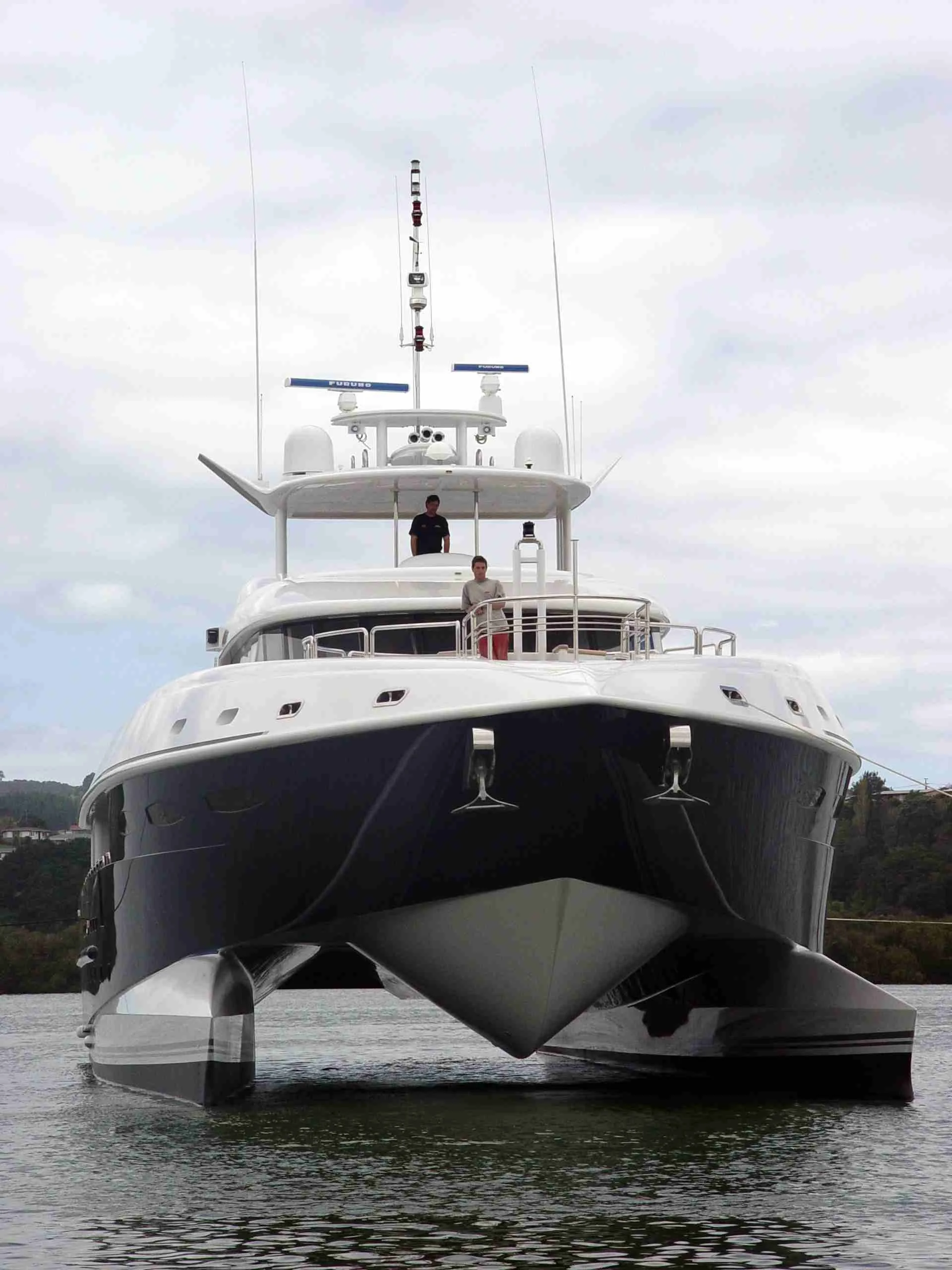
The Wavepiercer begins with a different question. Rather than asking how forcefully the bow will be lifted over the sea, we ask how little of the oncoming wave needs to lift it at all.
In our new designs the two demi-hulls are narrow and placed closer together than on a conventional cruising catamaran. Through midships, they remain comparatively parallel. Moving forward, the upper volume progressively disappears. There is no great shoulder of buoyancy waiting to be struck by the next wave; the change in immersed volume is far more gradual and linear.
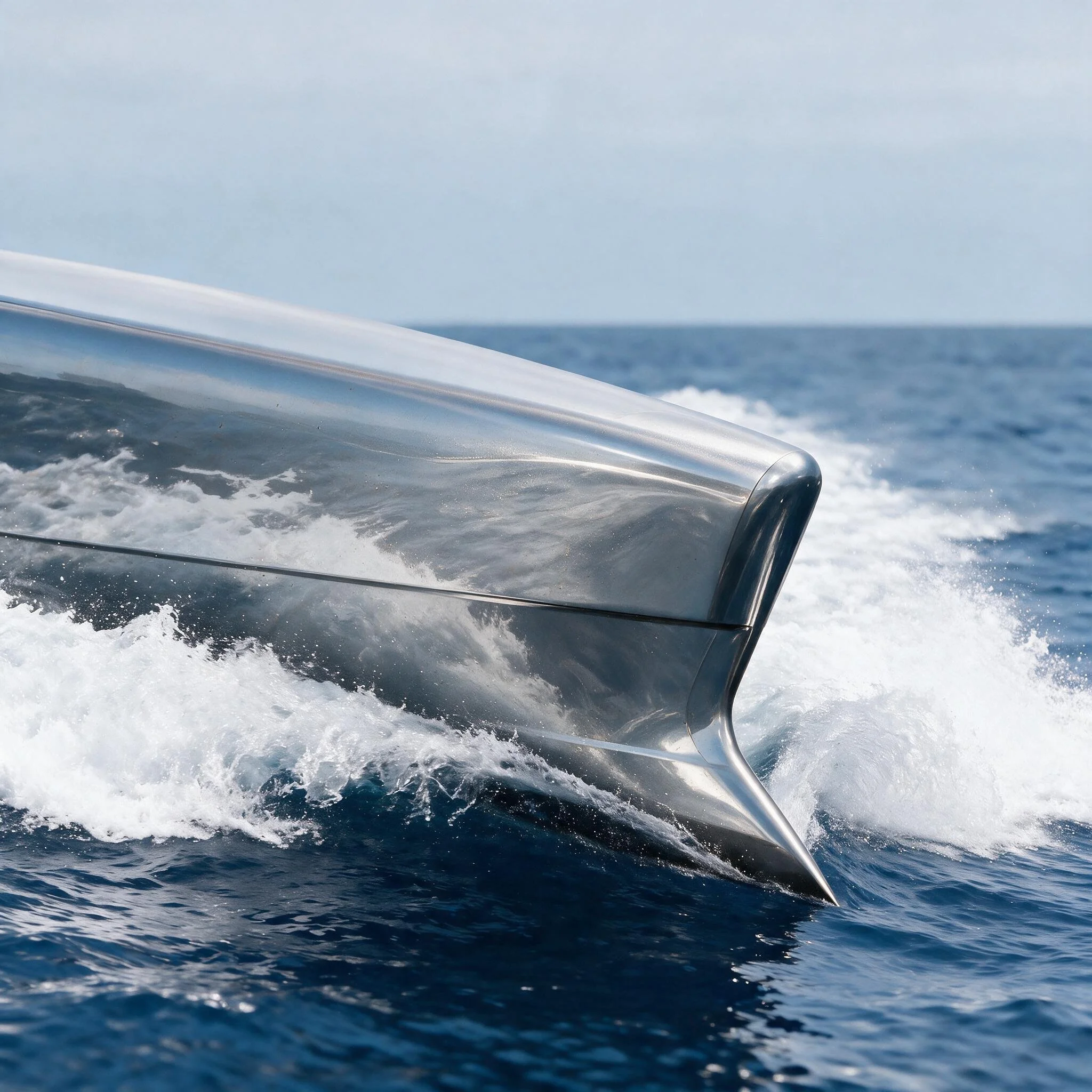
Demi-Hull
The effect is evident in the name. The fine bows enter the wave instead of scrambling over it. Water moves around them and between them. Because the bow is not thrust upward, the stern is not driven downward. The yacht remains closer to horizontal, and the familiar climb-and-fall cycle is softened.
Of course, the ocean always keeps a larger wave in reserve. A design that simply removed forward buoyancy would eventually meet a sea it could not manage.
This is where the NZY Wavepiercer becomes something more than a pair of slender hulls.
When the central bow awakens
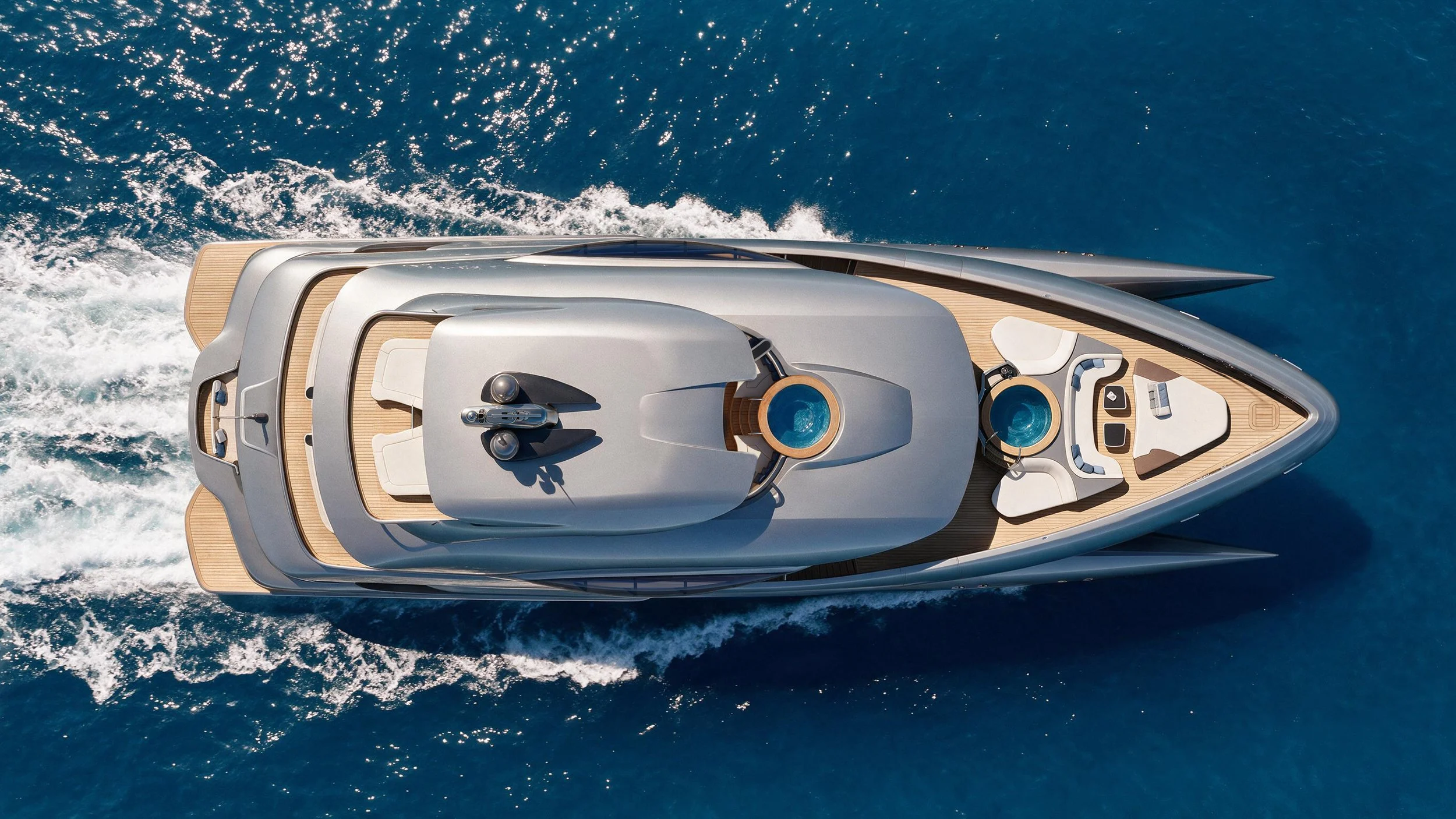
Suspended between the Wavepiercer demi-hulls is a sculpted and flared central hull. In ordinary conditions, it remains largely clear of the sea, allowing the outer hulls to do what they do best. As a larger or steeper wave rises beneath the yacht, the central bow begins to engage. Its buoyancy arrives progressively—later and more gently—lifting the vessel when lift is genuinely required.
It is rather like having a third hull that sleeps through the small waves and wakes for the important ones.
On the new 36-metre Endeavour, the exposed foredeck is approximately 5 1/2m above the waterline, with the underside of the main deck approximately 2 1/2m above the water. This is not the low, flat wing deck commonly found on a conventional catamaran. Nor is the central form merely a short nacelle or wave-break, as found on a commercial wavepiercer. It is a fully functional hull that runs the length of the vessel.
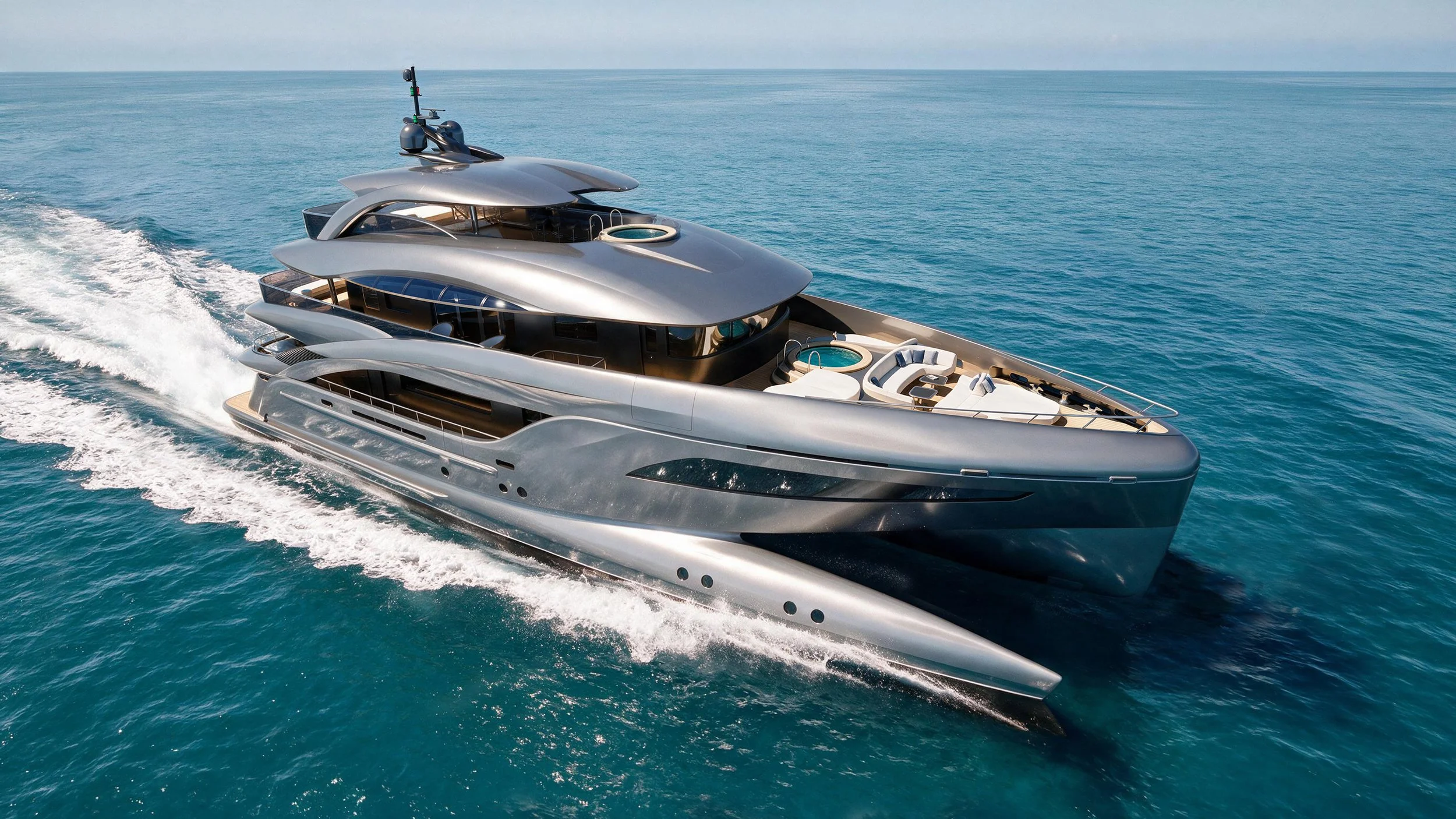
36m Endeavour
Under light conditions, the central hull is suspended above the water and has no role in the trim or ride of the vessel. In a larger sea, the central hull engages not only at the bow but along the full length of the vessel, providing buoyancy that works in cooperation with the two demi-hulls.
While the demi-hulls provide the majority of the support, all three hulls work together, moving the centre of buoyancy back and forth across the vessel as conditions change. The result is a noticeable improvement in overall stability.
The arrangement also changes the yacht’s behaviour at anchor. A monohull in a beam sea rolls around its centre of gravity. A conventional twin-hull vessel lifts and falls from one hull to the other as the crest passes beneath it. Fins can resist roll, but they cannot hold one side of a catamaran suspended above a trough.
On Endeavour, the fine demi-hulls and minimal inner demi-hull chamfer reduce rapid uplift, while the central hull provides support as either demi-hull encounters a trough. The improved stability comes from all three hull forms working together.
Twin-hull vessels perform well when the wind and waves are on the bow, but when the vessel is beam-on to the sea, keeping her at rest can be more challenging. In our experience, lowering the platform into the water can arrest much of this motion, provided the platform has been designed and built for that purpose.
The point is not to conquer the ocean
No hull eliminates motion, and no serious yachtsman claims to have defeated the sea. The purpose of the Wavepiercer is more intelligent: to avoid turning every wave into a contest between momentum and rapidly increasing buoyancy.
A yacht may look utterly convincing in a marina, where the water is flat and the light is kind. Her true character appears beyond the harbour entrance.
That is where guests discover whether speed must be exchanged for comfort, where captains discover whether the hull works with them, and where naval architecture stops being a drawing and becomes a physical experience.
Endeavour is not a conventional catamaran with sharper bows, and it is not a monohull divided into two. It is a three-part buoyancy platform: demi-hulls that pass through the ordinary sea and a suspended central hull that joins the conversation only when the ocean raises its voice.
Standing on the bridge, looking into the next wall of water, the distinction becomes wonderfully simple.
Most yachts prepare to climb.
The Wavepiercer prepares to pass through.