What Spirit Taught Us
Twenty years of listening to a yacht in the real ocean
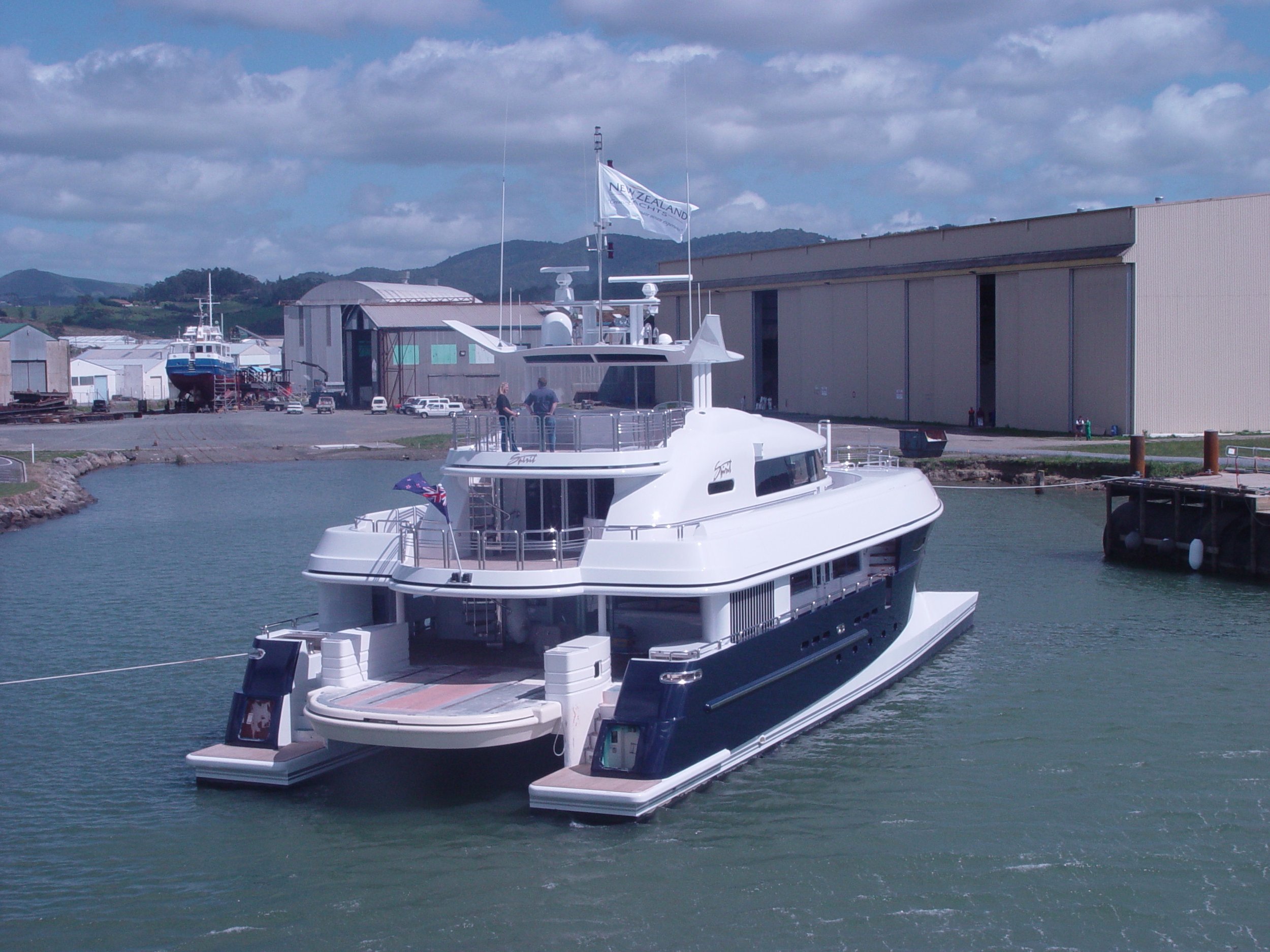
Before we rounded the Whangārei Harbour headland, the captain turned to the technical team and offered us a choice. We could stay aboard, or he could put us ashore in the nearest bay.
Ahead of us, 35-knots of headwind was driving down the coast against steep, closely spaced waves approaching four metres. Beyond the shelter of the land, there would be no comfortable place to reconsider. Every person aboard elected to stay.
That decision gave us four hours with Motor Yacht Spirit in conditions no designer would order for a promotional sea trial—and exactly the conditions in which a designer learns the most.
The best seat was below
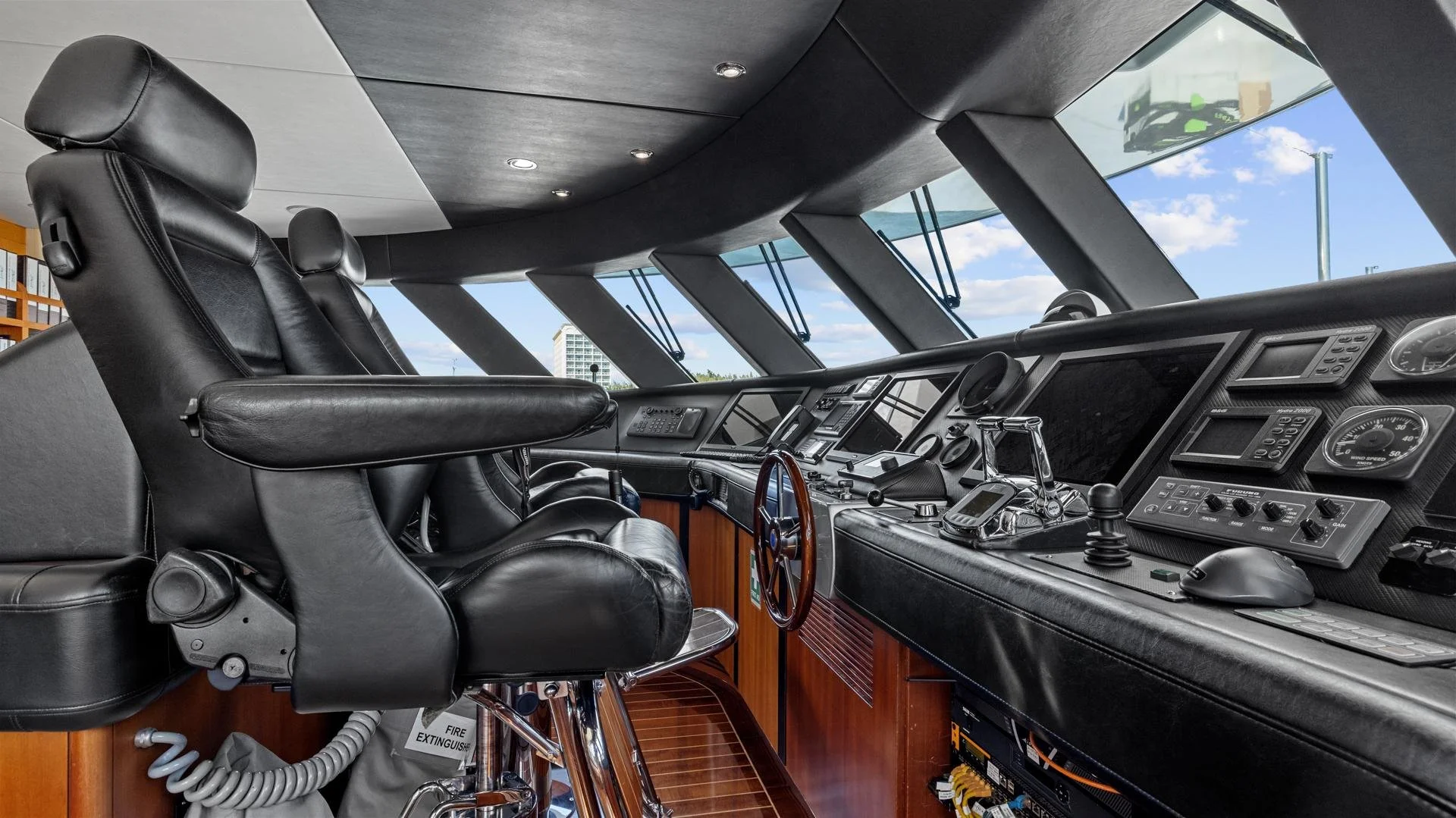
I began on the bridge, watching speed, trim and ballast while Spirit worked into the sea at approximately 17 knots. Her response was remarkably restrained.
I moved aft to the main-deck cockpit to study the platform and the water passing beneath us. It was surprisingly calm there; in fact, it was where I found most of the technicians, gathered at the stern and looking back at the seas we had just crossed.
Then I went below into a forward crew cabin inside one demi-hull. Through its portlight I could look across the central structure toward the opposite bow. It was the least glamorous vantage point on the yacht and, as it turned out, the most revealing.
I watched the fine hulls bridge the trough and enter the next approaching wave. Spirit carried a slight bow-up trim, holding the vessel aloft until the central bow settled into the approaching wave face. Water moved cleanly between the hulls. There was no violent impact and none of the blunt wing-deck slamming associated with conventional catamarans.
I could also see the forward portions of the demi-hulls flexing laterally under load. At that moment, the substantial carbon-fibre beam extending deep inside the hulls and toward the sacrificial bows made complete sense. On a drawing it was an engineering solution. From that cabin, in four-metre seas, it was alive and doing its job.
When faster became more comfortable
Spirit went on to teach us a lesson that seems to offend common sense: slower is not always gentler or more efficient.
At 10 to 12-knots in a long swell, her very narrow demi-hulls could roll and lumber. The yacht was moving in displacement mode but had not found the condition in which her hulls were happiest.
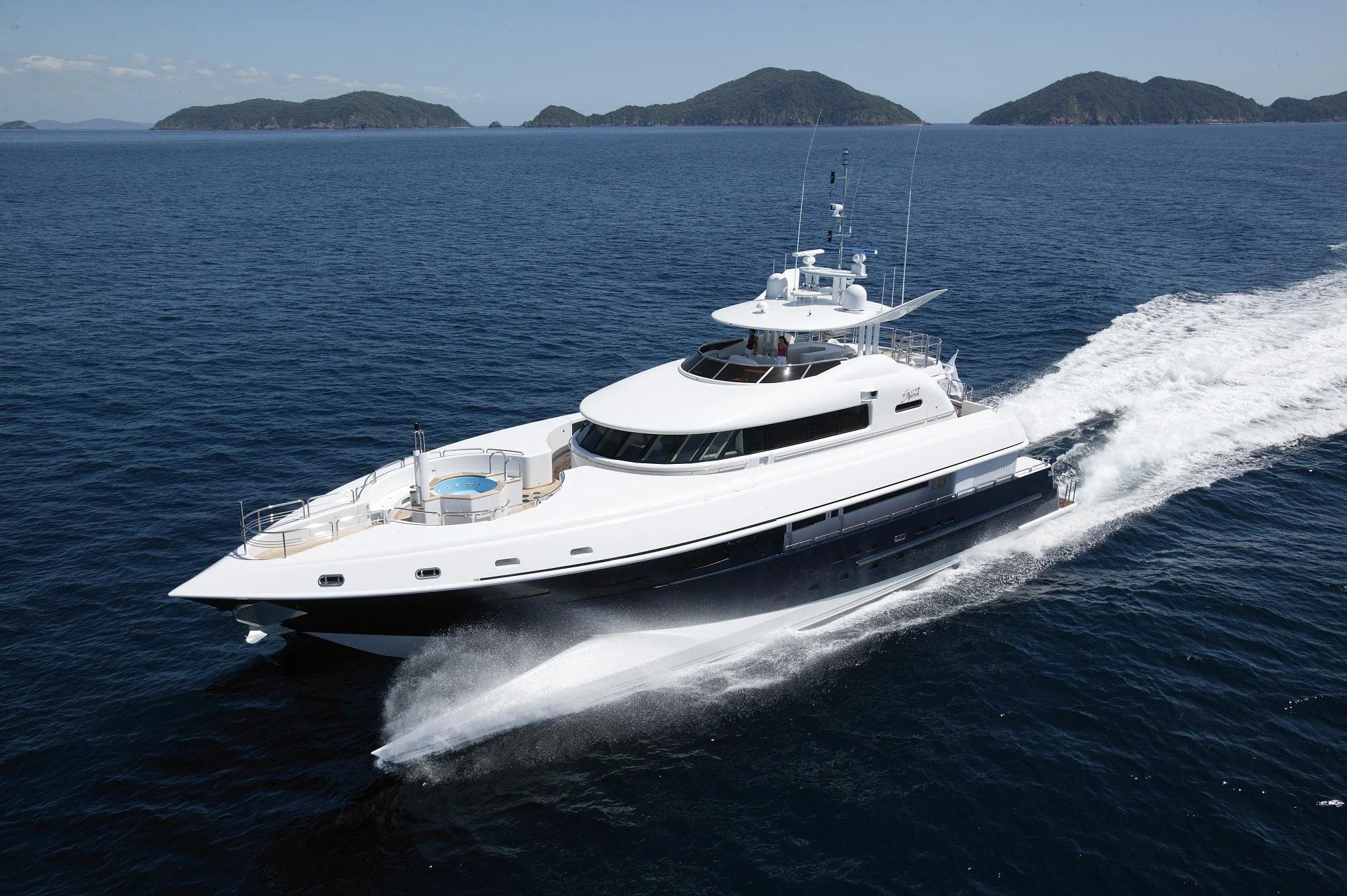
Above 20-knots, as Spirit entered the semi-planing regime, everything changed. She seemed to lock onto rails. The bow wave between the hulls cleared behind the stern, quartering seas produced less buffeting, and the reason for those long, slender hulls became unmistakable.
We saw the same principle expressed differently in shallow Bahamian water. Near the upper end of displacement speed, Spirit was pulled deeper into the water and generated a larger bow wave. Fuel efficiency suffered. Transitioning into semi-planing mode she lifted and accelerated, using her available power more effectively without a corresponding increase in throttle.
The lesson was not that faster is always better. It was that a yacht has a preferred relationship between hull form, speed, displacement and sea state. A captain who understands that relationship can sometimes improve comfort and efficiency by accelerating rather than retreating. Endeavour’s new ‘Tubular Transition’ demi-hulls carry that lesson forward, drawing on two decades of evolution with One2Three Naval Architects and hull technology proven aboard hundreds of commercial vessels.
The stabiliser hiding in plain sight
Years later, while Spirit was chartering in the Mediterranean, the sea offered another lesson. Wind and swell do not always consult one another. On occasion the waves arrived from a different direction and left the yacht lying awkwardly beam-on with guests aboard.
We lowered the large stern platform into the water. The effect was immediate. The motion stopped with an effectiveness everyone aboard could feel. The largest stabiliser available to us had been hiding in plain sight.
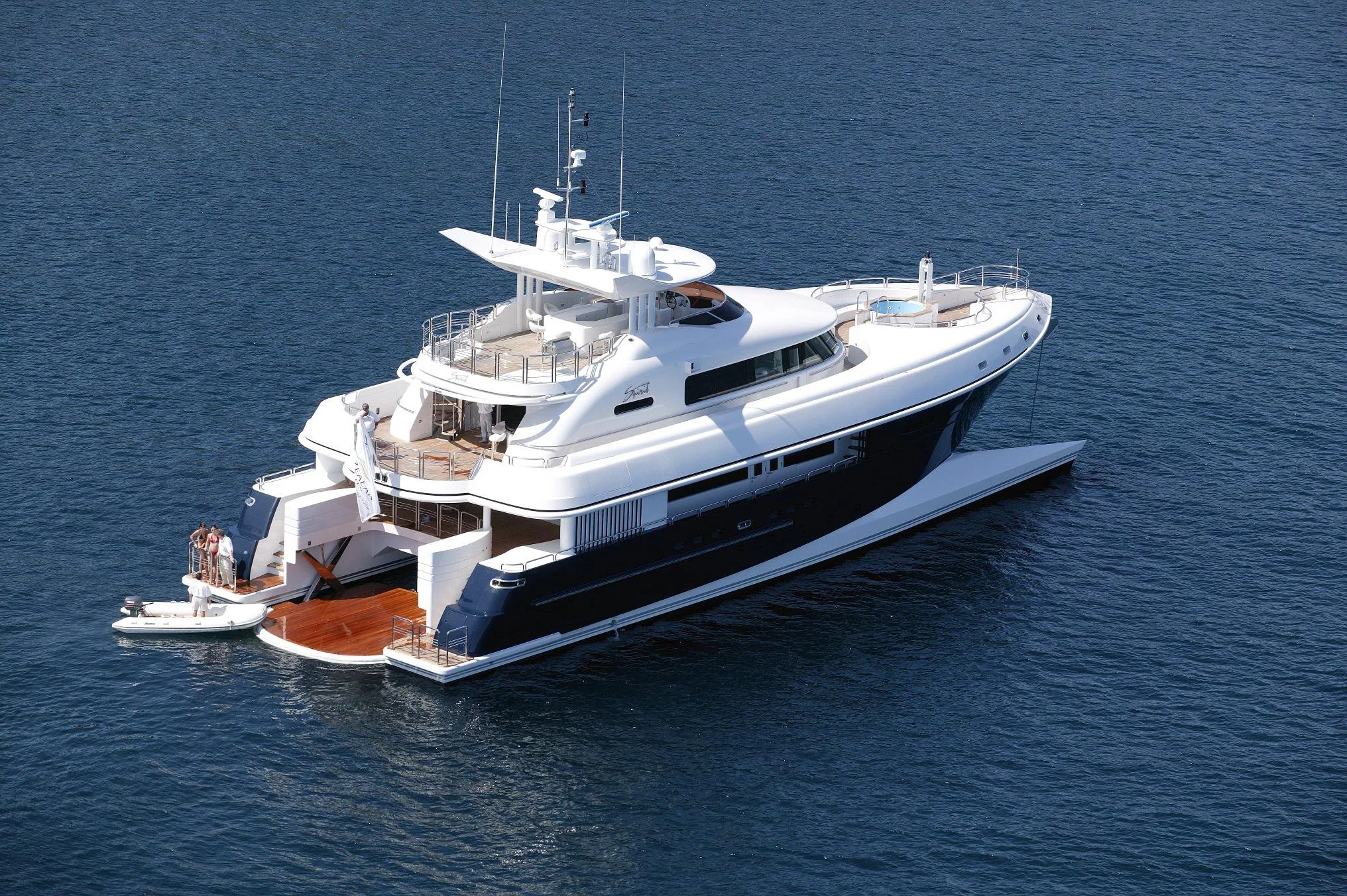
Spirit’s platform uses a scissor-lift mechanism rather than the more common cantilevered pantograph. I had already learned the importance of that decision the expensive way: the pantograph on my first Wavepiercer failed at the point where its forces were concentrated against the hull. Spirit’s scissor arrangement distributed those loads more successfully and remains operational after more than two decades of charter and private use.
The platform was also one of the yacht’s great social successes. Once the two tenders—or a tender and two jet skis—were launched, it became a water-level terrace for swimming, diving, dining with feet in the sea or simply sitting close to the ocean. But as soon as the equipment returned, that wonderful guest space became a garage again. Spirit had shown us both the answer and the next problem.
Listening—and building again
On Endeavour, the tenders and jet skis move into an enlarged central-hull garage, leaving the stern platform free for guests. Spirit’s central hull was largely occupied by water and ballast tanks; Endeavour’s greater volume allows it to do far more.
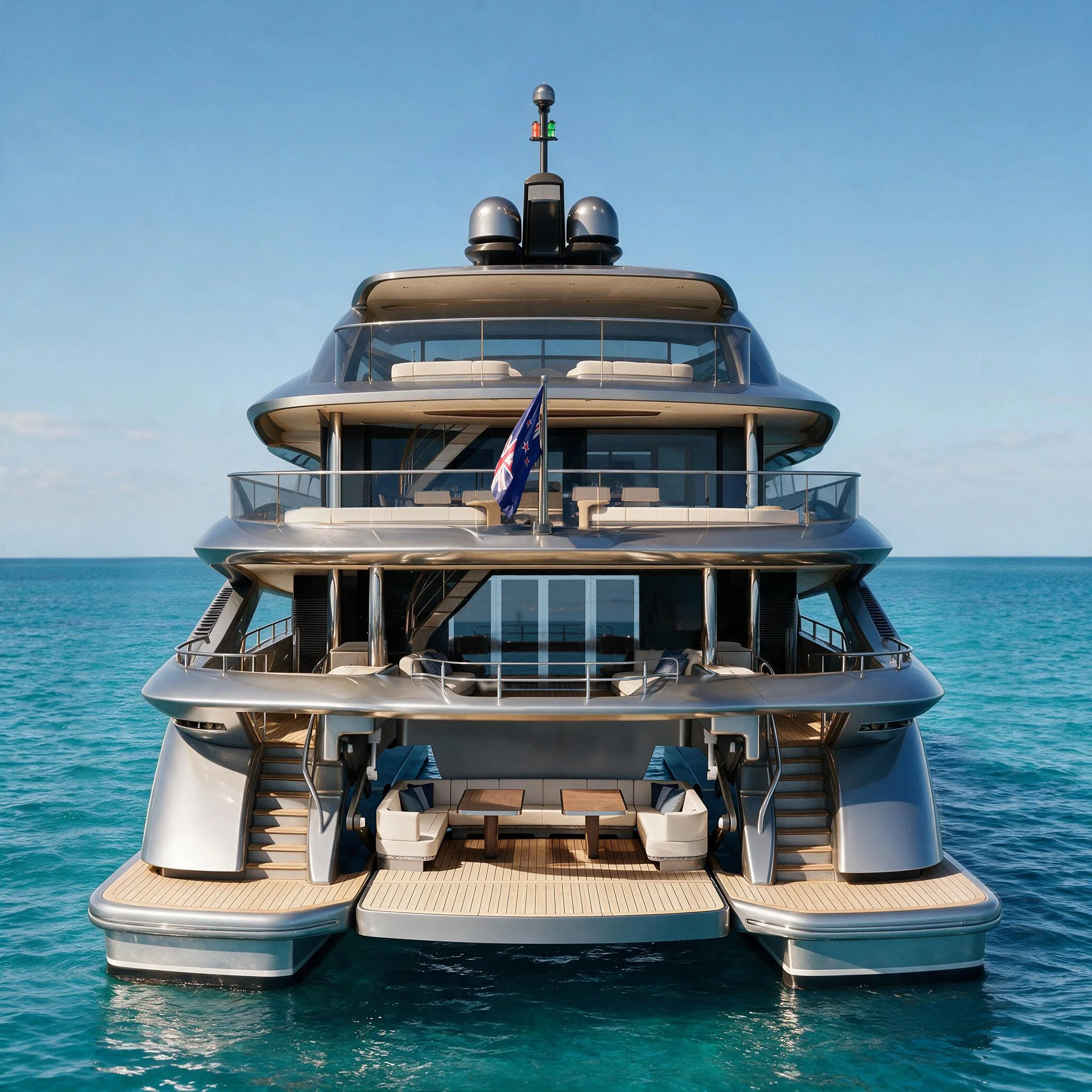
The machinery tells a similar story. Spirit’s large Caterpillar V12 engines consumed considerable space and made servicing difficult and expensive. Endeavour’s Volvo Penta IPS Professional 2700 arrangement recovers engine-room volume while adding efficiency, maneuverability and position-holding capability.
Spirit’s resin-infused composite construction was advanced for its time. Endeavour moves forward with extensive carbon fibre and accommodation modules isolated from the primary structure, creating quieter interiors without excessive weight.
None of these changes rejects Spirit. They honour her. She proved the Wavepiercer concept in real service, carried guests through oceans and then revealed, one voyage at a time, where the next vessel could be better.
Computer models tell us what should happen. Tank tests show what may happen. A yacht that has spent twenty years at sea tells us what actually happens—if we are humble enough to watch, listen and occasionally climb into the forward crew cabin when everyone else is enjoying the view from the bridge.
That is what Spirit taught us, and Endeavour is what we learned.